
When Does Surface Roughness Help Reduce Runoff & Erosion?
Surface roughness is commonly used in mine-site rehabilitation to help manage runoff and erosion, particularly in arid environments. However, its effectiveness depends strongly on the materials involved, the way runoff moves across the surface and the long-term stability of the roughness created.
In arid zones receiving approximately 200–400 mm of rainfall per year, average annual runoff may be only 10–50 mm. While many years may experience minimal runoff, individual runoff events can be considerably larger than these long-term averages suggest.
This creates both opportunities and challenges when using surface roughness as part of a rehabilitation strategy.
Surface Roughness & Runoff
Surface roughness can create depressions that temporarily pond rainfall that does not immediately infiltrate the soil. This can reduce or prevent the development of overland flow across rehabilitated slopes.
However, constructed roughness inevitably contains imperfections.
As water ponds in low areas, it can eventually overtop the roughness and form concentrated overland flows. In erodible materials, this overtopping can break down the roughness and initiate large rills or gullies, reducing or eliminating its original erosion-control benefit.
Rocky, erosion-resistant materials can behave differently. If the material resists erosion when overtopping occurs, surface roughness may remain intact and continue reducing runoff over a much longer period.
What Does the Modelling Show?
Landloch used the WEPP erosion model to investigate the effects of rip-line ponding on a batter slope near Kalgoorlie, Western Australia.
For a 27 m high slope with an 11-degree gradient, the modelling predicted:
| Ponding Depth | Average Annual Runoff | Average Annual Erosion |
|---|---|---|
| 100 mm | 2.9 mm/year | 0.6 t/ha/year |
| 50 mm | 14.7 mm/year | 4.5 t/ha/year |
| 0 mm | 40.3 mm/year | 21.2 t/ha/year |
Zero ponding effectively represents a situation where the rip lines have been overtopped and broken. The results demonstrate the potentially significant influence of maintained surface roughness on runoff and erosion.
For erodible materials, however, these benefits may only persist until the roughness is overtopped and eroded. For rocky, erosion-resistant materials, the benefits may persist considerably longer.
What About Vegetation Establishment?
Surface roughness can also influence vegetation.
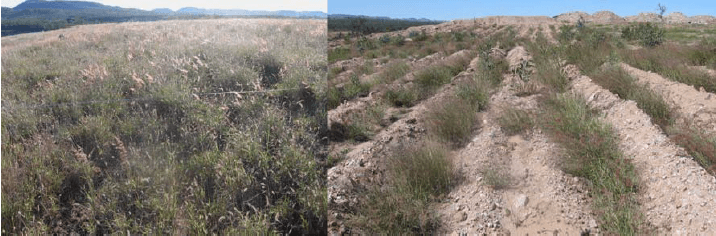
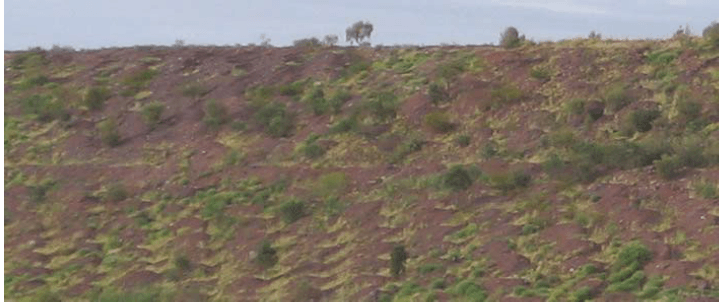
Large roughness elements create steep areas that may initially be unsuitable for vegetation establishment. In arid environments, this can sometimes be beneficial where runoff from steeper areas collects in lower areas, creating wetter zones that encourage seed germination and establishment.
However, on steep slopes — particularly under less arid conditions where vegetation groundcover is important for erosion control — excessive surface roughness can reduce the proportion of the surface available for vegetation establishment.
This may delay the development of sufficient vegetation cover to stabilise the surface.
Finding the Right Balance
Surface roughness can be an effective component of rehabilitation design, but its suitability needs to be considered in relation to material erodibility, runoff behaviour, vegetation establishment and the project’s short- and long-term rehabilitation objectives.
As the original Landloch paper concludes, rehabilitation practices and strategies need clearly defined priorities and goals that consider both immediate performance and how the landscape will develop over time.
Need Advice on Erosion & Rehabilitation Design?
Landloch combines field and laboratory erosion testing with erosion and landform evolution modelling to develop site-specific rehabilitation and erosion management solutions.
1 In drier areas, it is unlikely that the groundcover produced will be sufficient to be a major factor in erosion control. It is often unrealistic (in such areas) to place heavy emphasis on vegetation growth for that purpose.