
Runoff and Erosion Assessment
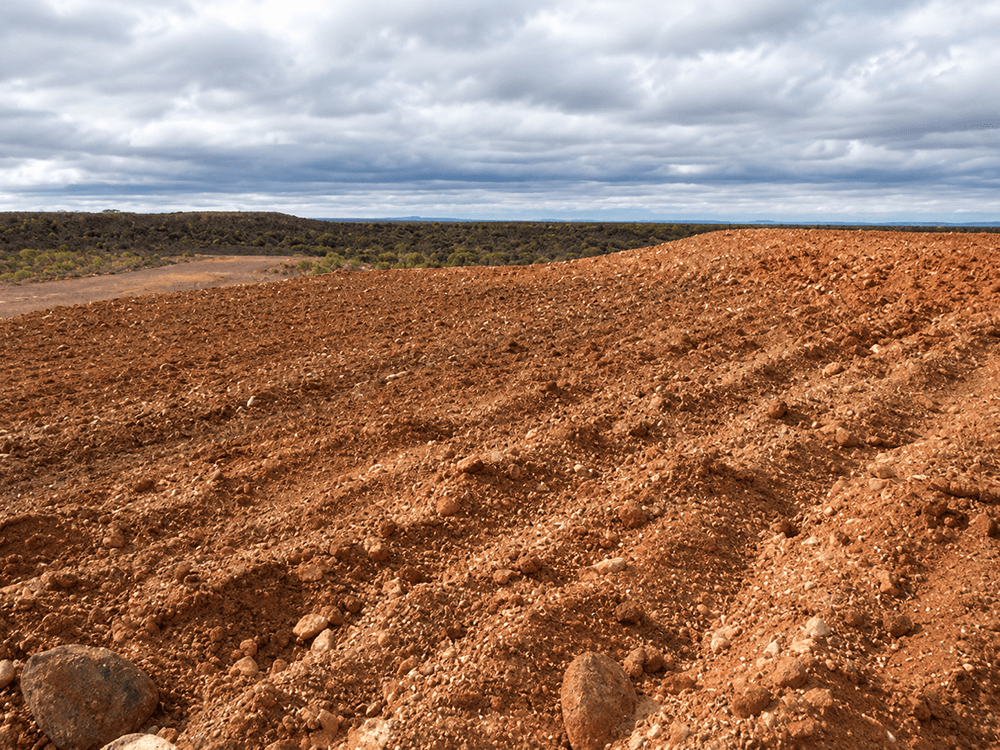
A study of runoff and erosion was carried out on the sound bund at Northparkes Mine in Central NSW, using simulated rainfall and overland flows.
The study considered soil and spoil materials, with field data collected to determine calibrated parameters for runoff and erosion modelling. Computer simulations provided key information to inform future management requirements.
The Influence of Vegetation on Soil Stability
For the topsoiled batters of the sound bund, both runoff and erosion were reduced through the establishment of vegetative cover.
Vegetative growth is intrinsically linked to soil properties. A comparison of data from batters that had been revegetated for either one or two years showed considerable improvements in soil properties over time under vegetation. These improvements included increased infiltration, improved soil aggregation and reduced erodibility.
Overland flow studies indicated that erosion rates did not increase with increasing flows, suggesting that slope length has little effect on erosion of this soil.
This finding is counterintuitive to the commonly assumed relationship between slope length and erosion but is consistent with a material for which erosion is limited by the transport capacity of runoff.
Spoil Material Assessment
Of the two spoil materials used in the sound bund, the white spoil was found to be slightly more erodible than the red spoil.
For this reason, and because of its greater water-holding capacity, the red spoil was recommended for use as the material underlying the topsoil wherever possible.
Computer Modelling and Long-Term Erosion Predictions
Computer simulations of infiltration, vegetative growth, runoff and erosion on the topsoiled batters showed that vegetation growth was strongly seasonal, but predicted an average long-term vegetative cover of 85%.
The predicted long-term erosion rate was low, at 0.8 t/ha/year for topsoil overlying red spoil, and was considered unlikely to cause significant siltation of bench channels.
For a design storm with a 500-year recurrence interval, simulations of runoff from the batters and flow within the bench channel indicated that the upper batter could be adequately drained by a bench channel with a 0.2% gradient.
Three drop structures, each capable of carrying peak flows of 200 L/s, were recommended to convey channel flow to ground level.
Vegetation Management Recommendations
Vegetation is essential to the stability of the batter and bench channel system.
For the batters, providing adequate surface cover during the most erosive period of the year is particularly important. There is also a need to introduce more perennial species and species that produce persistent, slowly decomposing dry matter.
The development of vegetative roughness is essential, and a range of grass species was suggested for planting within the channel.
Need Specialist Support for Mine Rehabilitation?
Landloch provides specialist soil assessment, rainfall simulation, erosion modelling and rehabilitation design services to support informed land management decisions and long-term landform stability.